

A candid conversation with Lake Nona landlords who are considering — or already attempting — to go it alone.
We get it. Your Lake Nona home is not just an asset. It has history. You chose the lot, selected the finishes, watched it being built. You know where the water shutoff is. You remember what the backyard looked like before the sod went in. It is personal.
And so when it comes time to rent it out — whether because you relocated, couldn’t sell in this market, or are building a rental portfolio — the idea of handing it over to a property manager feels unnecessary. Maybe even excessive. After all, how hard can it be? You find a tenant, collect rent, fix a few things. Right?
Let’s walk through what that actually looks like.
1. The Relationship Trap — And Why Tenants Know How to Use It
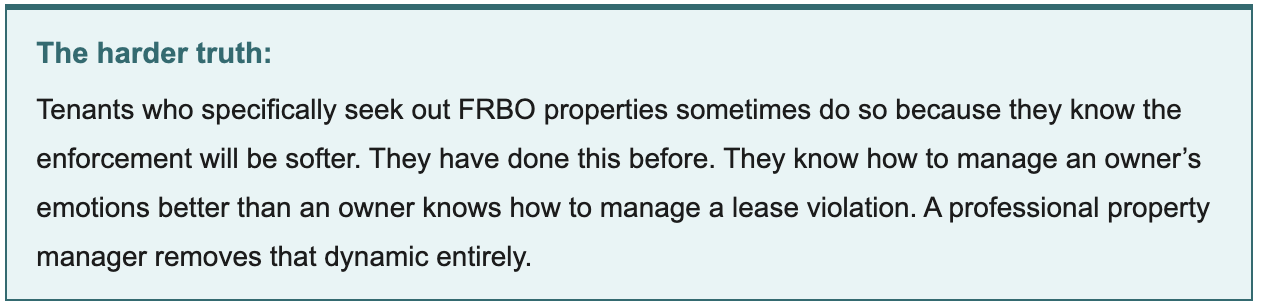
Here is something experienced landlords learn the hard way: a significant number of tenants actively seek out For Rent By Owner listings. Not because the property is better. Because the dynamic is different.
When a tenant knows they are dealing directly with the owner, they understand something important: you want to be liked. You want to believe in them. You do not want conflict. You want your beautiful home treated well and you want friendly, uncomplicated rent deposits every month.
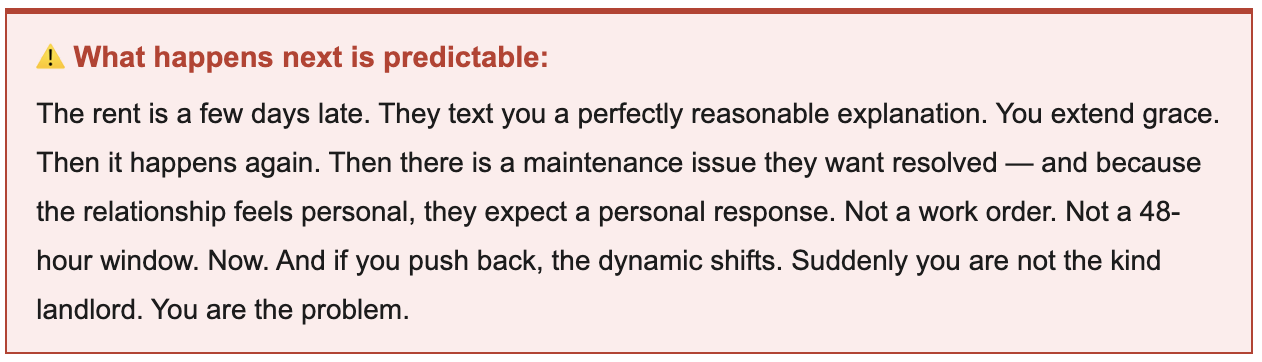
A professional property manager is not heartless. But they are the buffer. When your tenant has a complaint, it goes to us. When rent is late, we enforce the lease — not because we enjoy it, but because that is what the contract requires. The owner is protected. The relationship between owner and tenant never has to become adversarial because the owner is never the bad guy.
You get to be the investor. We handle the rest.
2. Fair Housing Laws — You Are Bound By Them Whether You Know Them or Not
This one keeps real estate attorneys very busy.
The Fair Housing Act is federal law. It applies to you the moment you list your property for rent. It does not matter that you are one person renting one house. It does not matter that your intentions are good. What matters is whether your actions — your listing language, your screening criteria, your responses to applicants — could be interpreted as discriminatory.
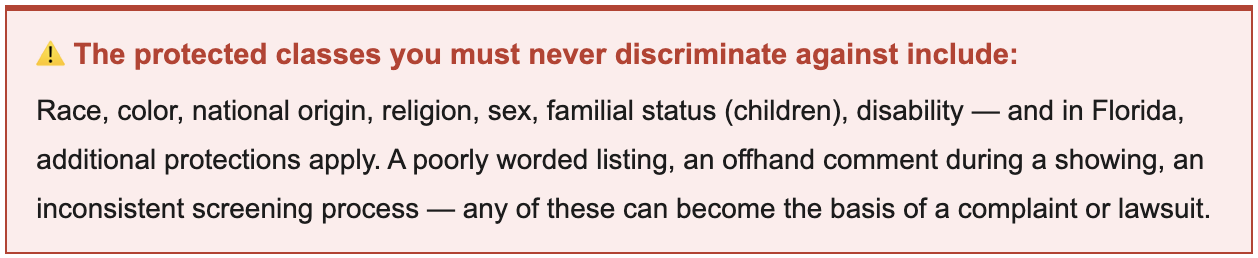
Professional property managers live and breathe Fair Housing compliance. Our screening criteria are documented, consistent, and applied equally to every applicant. Our listing language is reviewed. Our processes are defensible. Yours, as a first-time or occasional landlord, may not be — even with the best of intentions.
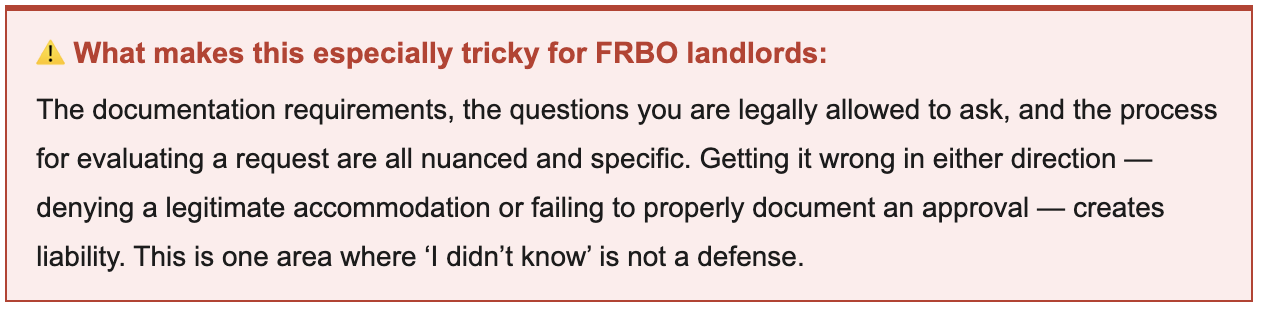
3. Service Animals and Emotional Support Animals — This Is Not Optional
If you have a “no pets” policy, you need to understand something critical: service animals and emotional support animals are not pets under the law. They are accommodations.
Under the Fair Housing Act, a landlord is generally required to make reasonable accommodations for tenants with disabilities — including allowing an assistance animal even in a no-pet property. Refusing a properly documented emotional support animal, or handling the request incorrectly, can expose you to a Fair Housing complaint.
4. Lease Compliance — You Are the Bad Guy, and Tenants Know It
A lease is only as good as your willingness to enforce it. And enforcement, when you are the owner, is deeply uncomfortable.
Think about what lease enforcement actually looks like in practice. A tenant has an unauthorized occupant. They have a dog they did not disclose. They painted the accent wall in the primary bedroom a color that violates the lease. Rent has not arrived and it is now the 6th.
With a property manager, these situations are handled by a professional with no personal stake in the relationship. The lease is enforced because that is the job. With a self-managing owner, every enforcement action is a confrontation between two people who have to maintain a living arrangement together. Many owners simply avoid the confrontation. The tenant learns this. The situation gets worse.
5. Personal Injury Liability — The Lawsuit Nobody Sees Coming
This has become one of the most significant and underappreciated risks in residential property management — and it is growing.
A tenant slips on a wet step during move-in. A guest trips on an uneven walkway. A child is injured by a garage door with a faulty spring. A visitor falls on an improperly maintained common area. These are not hypotheticals. They are the kinds of incidents that generate personal injury claims against property owners every single day.
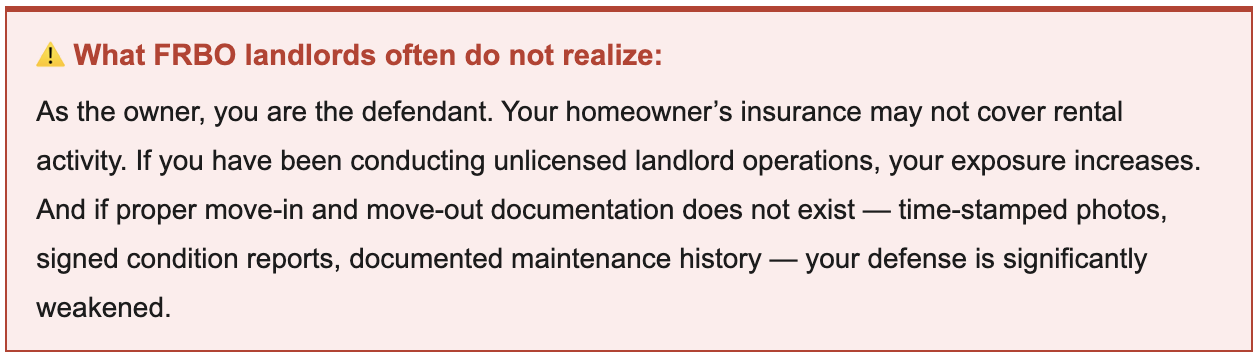
Professional property management includes documented move-in and move-out inspections, detailed condition reports, maintenance records, and licensed vendor networks. This documentation is not just good practice. It is your defense.
6. The Maintenance Savings Illusion
One of the most common reasons landlords go FRBO is the belief that they will save money on maintenance. They will do some repairs themselves. They have a friend who does HVAC. Their neighbor’s son does handyman work for cheap.
We understand the logic. And in the short term, it can appear to work. But here is what the math usually misses:
- Unlicensed work can void insurance claims and create liability if it causes further damage or injury
- DIY repairs by owners visiting the property create legal complications around tenant quiet enjoyment rights
- Delayed or improperly completed repairs escalate into larger, more expensive problems
- Tenants notice when maintenance is handled unprofessionally — it signals to them that the owner can be managed
- In Florida, there are specific legal timelines for responding to maintenance requests — violations can give tenants legal grounds for withholding rent
Professional property managers maintain relationships with licensed, insured vendors who have been vetted and who prioritize our properties because of volume. The quality is higher, the liability is managed, and the response times are documented. The ‘savings’ of self-managing maintenance are frequently illusory — and occasionally catastrophic.
7. Move-In and Move-Out — Where Disputes Are Won and Lost
Security deposit disputes are one of the most common sources of conflict between landlords and tenants. And in the vast majority of cases where a landlord loses, the reason is the same: inadequate documentation.
Florida law is specific about security deposit handling, timelines, and the documentation required to make deductions. A proper move-in inspection — with time-stamped photos, a signed condition report, and documented pre-existing conditions — is the foundation of every legitimate deduction at move-out. Without it, you are largely defenseless.
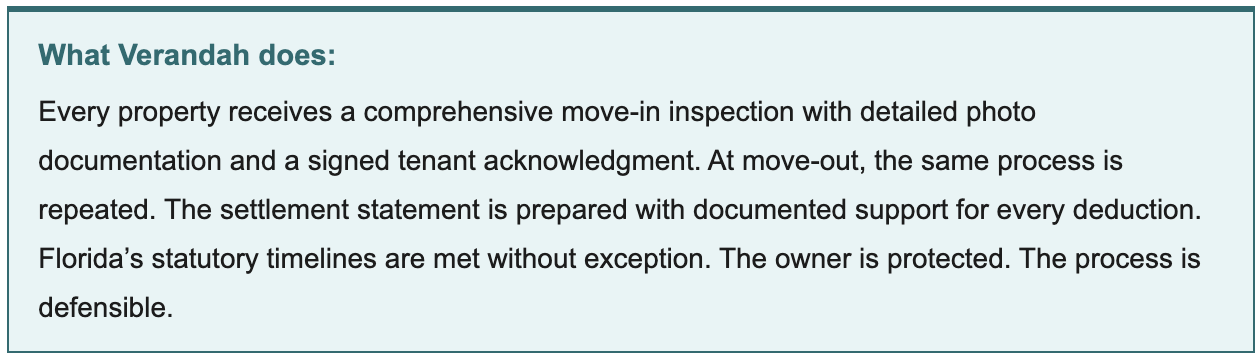
For a self-managing landlord taking photos on a phone and hoping a handshake agreement holds up in small claims court — this is a significant exposure.
8. Credit Reporting to Experian — A Tool Most FRBO Landlords Cannot Offer
Here is something that changes a tenant’s behavior in a profound way: knowing that their rental payment history is being reported to Experian.
Verandah Properties reports tenant payment history directly to Experian. For tenants who pay on time, this is a meaningful benefit — their responsible tenancy builds their credit profile. For tenants who pay late or not at all, this is a real consequence with real financial implications.
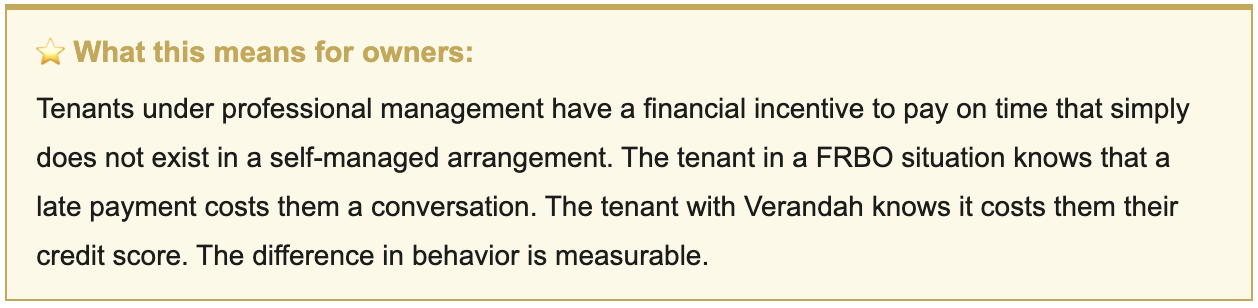
This is one benefit of professional management that is genuinely impossible for a self-managing landlord to replicate.
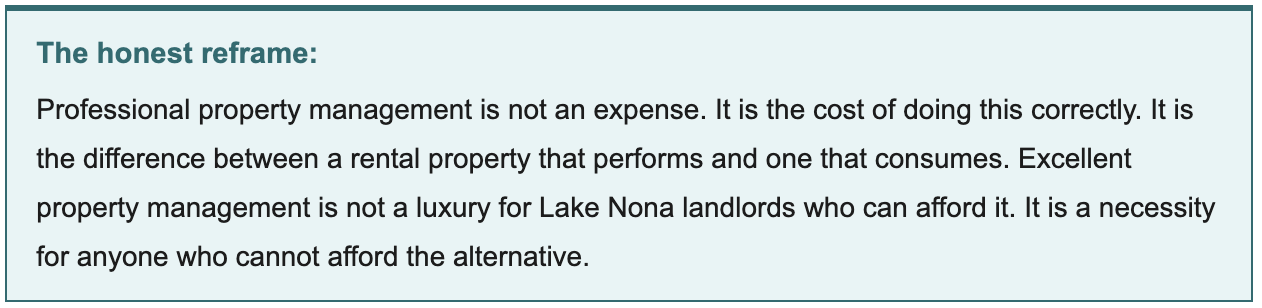
9. Can You Afford Professional Management? The Real Question Is the Opposite.
The most common objection we hear: “I just can’t afford a property manager.”
We understand that the management fee is visible and the risks of self-management are invisible — until they are not. But let’s put the math in honest terms.
One Fair Housing complaint. One personal injury claim. One security deposit dispute you lose because you had no documentation. One eviction you handled incorrectly. One tenant who stopped paying and stayed for four months while you navigated a process you did not understand. One unlicensed repair that caused water damage your insurance would not cover.
Any single one of these scenarios costs more than a year of professional management fees. Most of them cost significantly more.
We Are Here When You Are Ready.
If you are currently self-managing and wondering whether there is a better way — there is. If you are considering renting your Lake Nona home for the first time and trying to decide whether to go it alone — let’s have an honest conversation first.
Verandah Properties manages Lake Nona properties with a level of care, compliance, and personal attention that protects your asset, your income, and your peace of mind. Our Lake Nona Liaison provides in-person, white-glove service. Our Landlord Shield Coverage — exclusively available through professional property management — protects you against tenant damage, lost rent, eviction costs, and liability.
You worked hard for this property. It deserves more than a rent collector.
Start with a free, no-obligation consultation.
No phone call required. No pressure. Just the information you need to make the right decision for your property.